When should I water my lawn and for how long?
 Regardless of whether you live in the country or the city, the best time to water your lawn is in the early morning. This is the time of day when your lawn will absorb the most H2O and you will lose the lease H2O to evaporation. However, one bonus to watering in the early morning for city dwellers is that the water pressure will be at it’s peak before the population of you city gets up and starts using up all that water pressure for showers and baths! For rural folks, whose water comes from a well or direct from a lake, or pond or other source through an onsite pump.
Avoid watering during the day time, especially when the sun is at it’s brightest. Only a fraction of that precious water will actually make it to the grass.
How much should I water my lawn?
The amount you must water your lawn is largely impacted by the amount of rainfall you get where you live. This will be driven by the weather and a phenomenon called evapotranspiration (i.e. “ET”.) ET is the combined effect of water used by the plant and that which is lost to evaporation. ET is expressed in inches (or mm) of water per week. So based on the amount of water your grass takes in for nutrition and the amount of water that the environment takes out of the soil, you will have a new amount of water that has been debited due to ET and must subsequently be replaced. Often times a local university will have accurate ET rates for your area of the country. You may also be able to find these rates published regularly in the newspaper or on a website.
How deep into the soil should water penetrate?
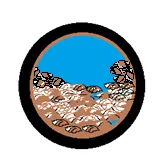
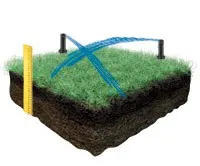 Generally speaking, water should be able to penetrate down 6-inches into the “root zone” of the lawn. Ideally it is time to water again when that water level is at about 3-inches. You can check this in a variety of ways, by using different tools such as a shovel, a soil sample puller, or a digital sensor.
How much is too much (or too little?)
Most people are surprised to discover that there is more damage done, by overwatering a lawn than by under-watering it. This is due largely in part to the plant structures inability to extract the water left in the soil once so much water has washed through it. Without the water to provide it nourishment the grass becomes susceptible to insect problems, physical damage and disease.
What happens to grass during a drought?
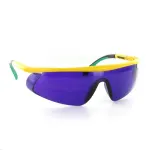
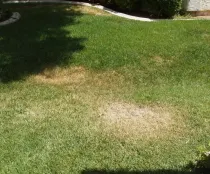
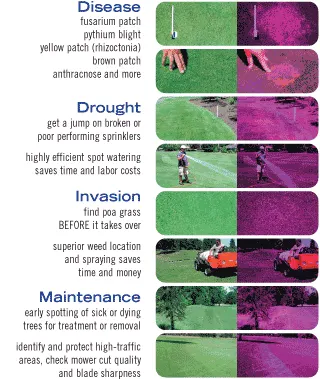 If your lawn can’t get enough water it will first go into a dormant stage, often marked by a bluish color. If the drought continues until the soil water is fully used, death will result for most cool-season grasses. Bermudas and other warm-season grasses will probably recover, however, the lawn’s quality will not.
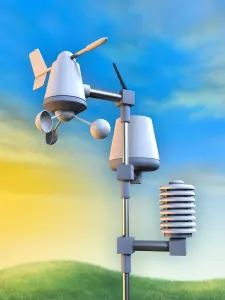



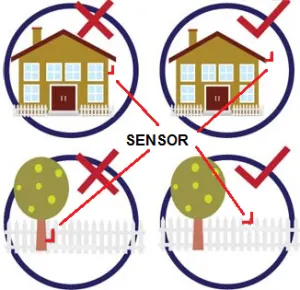 comes down, sensor gets wet. When it gets wet enough it stops irrigation. Some rain sensors suspend irrigation immediately during rain events without need for rainfall accumulation. It rains, they stop.
 Rain/freeze sensor. A rain/freeze sensor handles rain just like the standard rain sensor, either on accumulation or immediately upon rainfall. They add the advantage of shutting irrigation down before the water sprays and icicles and ice patches form on your yard and drive. The most common sensors stop activity when the temperature reaches about 37 degrees. Some models let you choose the shut off temperature, ranging from 35 to 45 degrees. The irrigation remains off until the temperature warms to above the freeze cut off settings. The rain/freeze sensor looks pretty much like a standard rain sensor.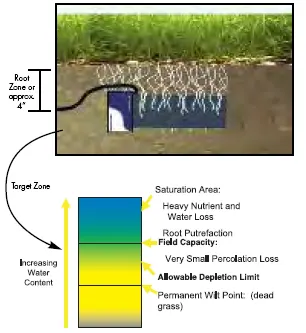

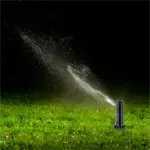
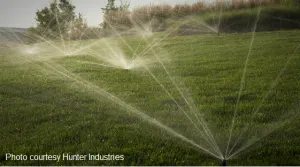 great deal of water out of one nozzle, they produce multiple streams of water of lower volume. These streams come out at different angles, some high, some low, ensuring even coverage. If you have sloped land the slow, even coverage minimizes the chance of water runoff. Blasting gallons of water every minute at sloped land just encourages runoff, as the soil cannot absorb the water as fast as it is applied.
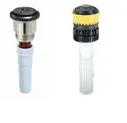 assemblies. The stream nozzles simply swap out with the standard spray nozzles and you are in business. Rain Bird and Hunter have every situation covered.
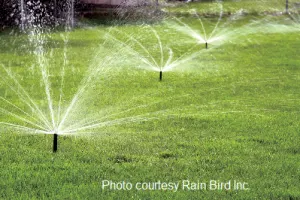 Not sure why you want to get rid of your old nozzles? Two good reasons come to mind. First, the stream nozzles cover up to 30 feet, where spray nozzles stop around 15 to 17 feet. This means that in many systems you can have the same coverage while eliminating a number of heads, saving water. Second, stream nozzles are not as sensitive to breezes as spray nozzles. The droplets are bigger and heavier; they go where they should when standard sprays are being blown away. Wait, I’ll add a third, no charge. A zone with stream rotors can use 30% to 40% less water for the same coverage. Less water = less money.