Ok. Not nuzzle. Couldn’t think of a good title. Some people say I never do.
I’ll get down to business. Most people know about the average, used everywhere nozzles. If you don’t then check out sprinkler nozzles. These generally do the job and are all most people will ever need.
There are a number of specialty spray nozzles available for increased water efficiency, problem areas or special applications. Normally I avoid naming particular brands and products, preferring to give general information. This is the exception.
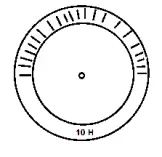
The first is the Toro Precision Series spray nozzle. While this is not technically a specialty nozzle it has some advantages over competing spray nozzles. The Precision Series has something they call H²0 technology which puts an oscillation on the spray . I’m sure the H20 name has nothing to do with the scientific name for water. Pure coincidence. Anyway, quoting Toro, “Using patented H²0 chip technology – and no moving parts – each Precision Series Spray nozzles creates one or more high frequency oscillating streams to achieve the desired arc and radius with 1/3 less water usage.” Yup. Sounds cool. But looks even better.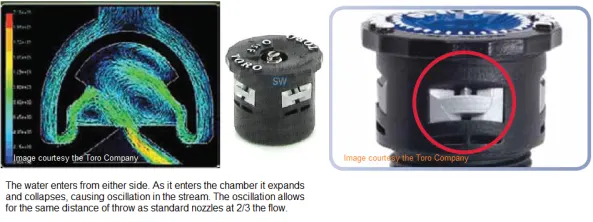
Ok. Pretty pictures and lots of marketing fluff don’t mean much without the facts. Comparing the Toro Precision nozzle to two major competitors:
| Radius/ Feet | Pattern | GPM @ 30 psi | Difference GPM | |
| Toro | 15 | Full circle | 2.31 | —– |
| Brand A | 15 | Full circle | 3.72 | +1.41 |
| Brand Z | 15 | Full circle | 3.70 | +1.39 |
| Toro | 15 | Half circle | 1.16 | —– |
| Brand A | 15 | Half circle | 1.86 | +.70 |
| Brand Z | 15 | Half circle | 1.85 | +.69 |
You might ask “If these are so good, why aren’t more people using them?” Good question. Thanks. The only downside to these nozzles appears to be the price. The Toro Precision sells for roughly 2.5 times the cost of standard nozzles. That can make noticeable difference in installation costs for an entire system. However if you are in a retrofit or repair situation and need to have better control over your precipitation, fix a zone that has been expanded beyond capacity, or control run off on slopes they offer you some valuable options.
Let’s talk about Rain Bird Rotary Nozzles. These cover a radius of 13 to 24 feet. Their big advantage is the ability to match these to the Rain Bird 5000 rotor series and get the same precipitation rate. Let’s say you have a large area that will be covered by rotors and a small area next to it, say 20’ x 20’. Normally the smaller area would require its own zone using spray heads on pop ups. With Rain Bird Rotary nozzles you can now cover the area with one zone and get the same precipitation rate. Use the 5000 rotors for the large area, the rotary nozzles for the small one. You’ve eliminated one valve, the wiring and one zone requirement on the controller.
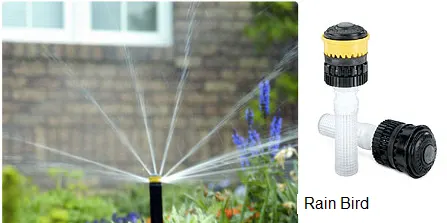
Because of their low precipitation rate they are very good for watering slopes. The slower precipitation rate gives the soil more time to absorb the water, minimizing run off.
Next is the Rain Bird U-Series. In a perfect system you have head to head coverage. Most sprays do well on the far coverage but lack real coverage in the first couple of feet out from the nozzle. Head to head coverage means that the area missed by head A is now covered by head B. In many cases, due to poor design, changing landscape or deteriorating systems, this no longer occurs and you get dry areas around the head. The U-series has a second nozzle for greatly improved close in coverage. While not as good as head to head coverage it sure comes close.
This is beginning to sound like a Rain Bird advertisement. Not intentional, it’s just the way the nozzle sprays…
Now we have the lovely and talented Rain Bird SQ series nozzles. The SQ stands for square pattern. These put out a true square or rectangular pattern with edge to edge coverage. Most square pattern nozzles aren’t. On that I can speak from experience.
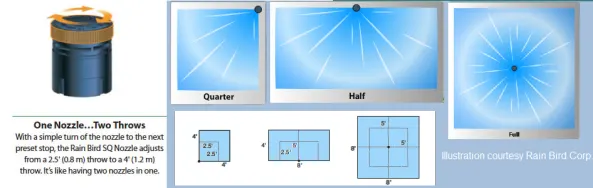
The SQ offers two settings so one nozzle throws 2.5′ or 4′, changeable with a simple twist of the top ring. It has a pressure compensator built in and fits standard pop ups and risers. It is also pretty low flow, using only .46 gallons per minute at its largest setting. Having a square pattern helps eliminate the waste that occurs when you try to match half and quarter circles to cover a narrow rectangular pattern.
And remember, if you are getting enough rain you need to muzzle your nozzles.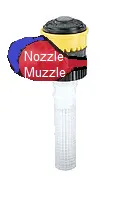 Get a sensor.