Silly you. You thought ½” tubing measured ½”.


Half inch tubing is literally the backbone of many drip irrigation systems. It is by far the most popular size used.  The only problem is half inch tubing isn’t half inch.  It’s close! Closer than ‘hand grenade’ close. More like ‘electric razor’ close.
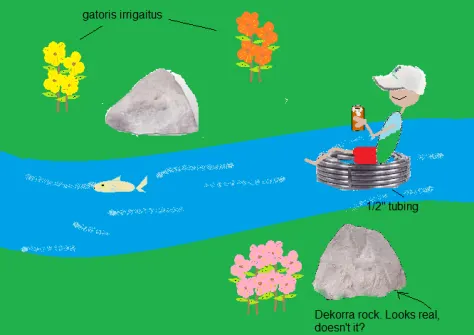
 

Piping has specific dimensions. Steel, iron, copper, pvc all have set standards set by ASTM International.  This means that the steel pipe you buy in Maine will fit the fittings you buy in Nebraska and connect to the existing pipe in Alaska.

Plastic tubing? No, no real standards.  The size can vary from manufacturer to manufacturer or even within the same manufacturer.  The term ½” is known as the nominal size, or the industry trade description of the product. As they say in the diet commercials, your results may vary. A lot, actually.

Irrigation 1/2-inch polyethylene tubing is available in different configurations:

1/2-inch – .570″ ID x .670″ OD     1/2-inch – .580″ ID x .700″ OD
1/2-inch – .600″ ID x .700″ OD    1/2-inch – .620″ ID x .710″ OD

Why do you care?  Honestly, the sizes are so close they won’t have much effect on water flow, especially the two biggest. You care because fittings don’t always fit. It’s easy to buy a ½” fitting that won’t fit a ½” tube.

It is important when building a drip system to check the internal diameter of the tubing against the size of the fittings you need. While always buying the same brand of tubing and fittings help it is not a guarantee of fit. The two fittings in the picture are from the same company.  They are not interchangeable. If you put the .520” in a .600 ID tube and clamp down tight enough it should hold. You can’t put the .600” in a .520” tube without deforming the tube.
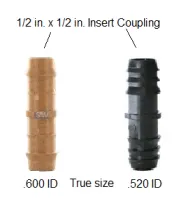
Before you buy your system take a moment and verify dimensions. Look at the barb fittings  and you see the specs are given for each piece. All you need to do is match them to your tubing.

Fortunately, ½” tubing seems to be the only product with this problem. The ¼”, ¾” and 1” are all consistent in sizing.
How we picked our team. Irrigation supplies, major league


Ever wonder why a company picks certain products to carry?  Sometimes it is obvious: if you are going to sell groceries you need to sell Kraft products. Sometimes it is not, like the Tabasco flavored tequila now on the market. Don’t try that one. Seriously.

Choosing the product lines for Sprinkler Warehouse involved both the obvious and the lesser known. The major requirement of each brand was that it was reliable, did what it said it would do and would show our pride in our company.

The obvious. You cannot discuss irrigation without involving Hunter and Rain Bird. Both of these companies are dedicated to irrigation and produce a full line of products. It would be extremely difficult to think of an irrigation requirement that they cannot fulfill.

There are a few others.

The one you’ve heard of but didn’t think about for irrigation.

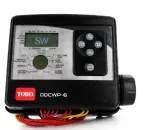
The Toro Company. Ever wonder why it’s named “Toro”? I did. Seems it was started in 1916 to build tractors for Bull Tractors. Fits right in there, doesn’t it?  Toro is most famous for its commercial and residential lawn and tractor equipment, snow blowers and utility vehicles.  Not as well known is the fact Toro has been in the irrigation business since 1962. They produce a full complement of irrigation supplies and have one of the most innovative controllers on the market, the battery operated and waterproof DDCWP. They also produce the highly efficient Precision Series spray nozzle.

Some you may not have heard of but need to.

The K-Rain Corporation.  It’s not often you find a company started by a rocket scientist. This one is. It was founded 1974 by Carl Kah, a former manager of the U.S. Air Force’s reusable rocket engine program. According to Carl, “Thespace program set an example for all of us in business to follow. There is always something that needs to be improved.”  K-Rain keeps improving, having over 90 patents so far, including one for the Indexing valve, a Kah invention that reduces the need for five valves down to one. Their continuing quest for improvement enables them to bring quality products to market with prices noticeably lower than many of their competitors.

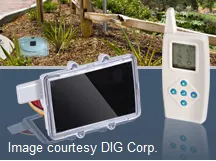
The DIG Corporation. DIG was founded in 1981 to do one thing and one thing only: provide efficient, cost effective low volume irrigation systems. “Low volume” is commonly known as drip or micro irrigation. That’s all they do and they are very good at it. They have anything you can think of for a drip system, whether it’s in your garden, your flower pots, under turf or in plant nurseries. They drip, spray, fog, mist and stream. They also provide the LEIT controllers. Powered by ambient light, LEIT controllers are much more sensitive than solar power, giving you more options for controller locations.

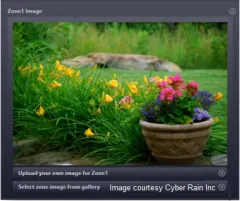
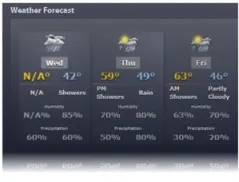
Cyber Rain Inc.  No other irrigation controller out there is as versatile, flexible, high-tech and just flat cool as the Cyber Rain Cloud controller. Need shade, order up a cloud, no problem! (sorry, couldn’t resist.) The Cyber-Rain Cloud controller does everything you can ask for and you control it from anywhere. Whip out your Android, iPhone or Blackberry phone, check your system performance, make changes and, instead of Zone 1 or Zone 4 you see a picture of the area. Why remember zone numbers when you can see what it covers? It checks the weather and automatically adjusts your irrigation schedule to match and, since Cyber-Rain uses the internet, weather updates are always free! Now folks, that’s pretty hard to beat.

Every member of our team was drafted after careful consideration. We’re glad to have them and look forward to the upcoming series/bowl.

Backflow = upchuck? Eeeewww…


Most people know they need a backflow for their irrigation system. They just don’t know why. I’m going to work this backwards. First I’ll show what can happen if a backflow is missing or broken. Then I’ll tell you how they work and why you want one for your system.

From the West Virginia Department of Health and Human Resources: “One of the most highly publicized cases of a backflow incident occurred in 1969 at Holy Cross University. The football season was canceled due to a large outbreak of infectious hepatitis among the team members. It was determined that backflow through an unprotected lawn sprinkler system at the practice football field caused the epidemic. Children carrying the hepatitis virus routinely played in puddles around the sprinkler heads. Fire fighting demands in the vicinity caused negative pressures at the sprinkler heads backsiphoning the contaminated water into the drinking water supply to the field.

One of the most famous cases of backflow occurred in California. A laborer had been using an aspirator attached to a garden hose to spray a driveway with weed-killer containing arsenic. At sometime during his work, the water pressure reversed. The man then disconnected the hose and unwittingly drank from the hose bib. Arsenic in the waterline killed him.”

Thirsty yet? Try this from the Environmental Protection Agency: “In 1991, an atmospheric vacuum breaker valve intended to protect a cross-connection between an irrigation system and the potable supply malfunctioned, allowing backflow of irrigation water into the public water system. The water system, located in Michigan, was contaminated with nematodes, rust, and debris.

In 1981, chlordane and heptachlor were backsiphoned through a garden hose submerged in a termite exterminator’s tank truck in Pennsylvania. An undisclosed number of illnesses occurred, and 75 apartment units were affected.”

THE BASICS If you lose water pressure to your house, for whatever reason, the water in the house will flow out to the main line. Because pressure is now reversed, going from house to main line, it creates a siphon effect and will pull anything in the sprinkler system and in the puddles around the sprinkler system with it. If your garden hose was on at the same time it becomes a siphon hose. Now all the fertilizer, insecticide, animal waste and many other things you don’t want are pulled into the drinking water.

GARDEN HOSE Notice the two involving garden hoses? How many of us drink from a garden hose when working outside on a hot summer day? Ever use that same hose to put out pesticides or fertilizer? Have a backflow preventer on the hose bib? Cheap, cheap protection.
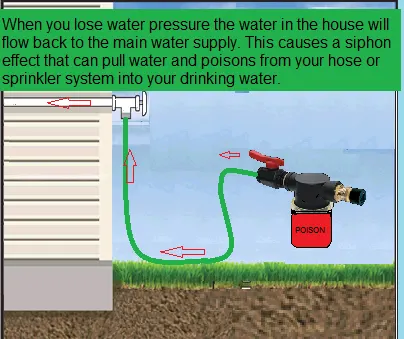
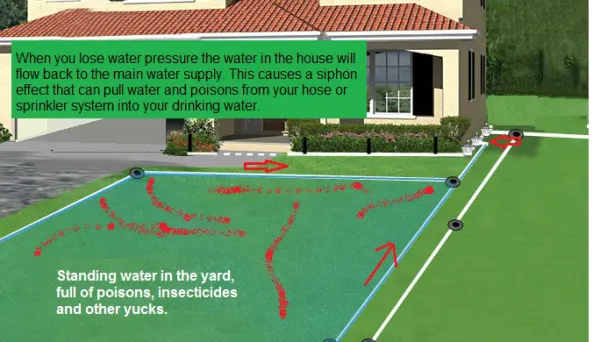
I think it is important at this time to note that our very talented graphics department has absolutely nothing to do with the illustrations in this article. I stole their work and added my own touches.  I get the blame.

IRRIGATION SYSTEM Same principal. Have another bad drawing. A backflow works by shutting down the irrigation water line when you lose water pressure. The simplest works just like a stopper in your bathtub: a plug falls down, blocks the line. They get far more complicated, depending on application.

Don’t listen to your neighbor, me, anyone else on what type of backflow you should get. Ask your city or county or your water provider. In my area a pressure vacuum breaker is plenty. Two miles away a new jurisdiction starts and they insist on double-checks. Always verify local code requirements first.

To find out the different types of backflows look at the backflow section on sprinklerwarehouse.com. To learn more about how they work check out backflows in Sprinkler School.

And stop drinking from your garden hose until it’s protected. Lemonade sounds better anyway.

Can’t afford a trip to the Bellagio? Stream rotors + your music + your lawn chair = you’re there!


The fountains at the Bellagio, Las Vegas, are world famous. They are designed to take you away from stress and trouble with their combination of dancing water, music and light. They are not, however, designed to keep you from gambling.

Each performance is a unique interpretation of a classic piece of music.  Their definition of classic covers a broad spectrum: Mozart, Glenn Miller, the Beatles and more. I hope they are working on Hank Williams. That might take a while. His work is pretty complicated.

If you can’t make it to the Bellagio, bring the fountains to you. Get stream rotors for your yard. You will enjoy the relaxing show and you will water your yard at the same time. Having a beautiful yard helps you relax even more. You benefit in many ways.

Stream rotors are different from standard rotors in that, instead of blasting a great deal of water out of one nozzle, they produce multiple streams of water of lower volume. These streams come out at different angles, some high, some low, ensuring even coverage. If you have sloped land the slow, even coverage minimizes the chance of water runoff. Blasting gallons of water every minute at sloped land just encourages runoff, as the soil cannot absorb the water as fast as it is applied.
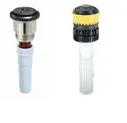
In traditional stream rotors the Toro 340 is the answer. Designed to replace impact or gear driven rotors with a ¾” inlet it covers from 15 to 30 feet. It also has 9 easily set patterns to cover most any area. Great coverage, great application.

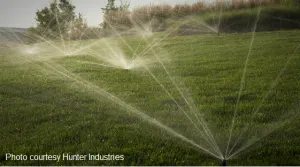
Don’t have a commercial application? Looking for the Bellagio effect at your home? No problem. In the last few years a number of manufactures have developed stream rotors that fit standard pop-up spray assemblies. The stream nozzles simply swap out with the standard spray nozzles and you are in business. Rain Bird and Hunter have every situation covered.
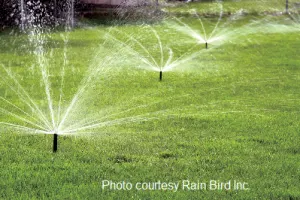
Not sure why you want to get rid of your old nozzles? Two good reasons come to mind. First, the stream nozzles cover up to 30 feet, where spray nozzles stop around 15 to 17 feet. This means that in many systems you can have the same coverage while eliminating a number of heads, saving water. Second, stream nozzles are not as sensitive to breezes as spray nozzles. The droplets are bigger and heavier; they go where they should when standard sprays are being blown away. Wait, I’ll add a third, no charge.  A zone with stream rotors can use 30% to 40% less water for the same coverage. Less water = less money.
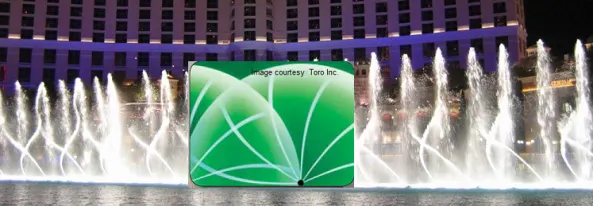
The reason for their efficiency lies in their pattern. Small streams, slow application and constant, even movement add up to  more consistent, usable irrigation.Take a look at the spray pattern below.

Notice how closely it matches the Bellagio fountain pattern? Quality knows quality.

So turn on the stream nozzles, add music, sit back and enjoy the show. You can charge your neighbors admission if you wish. After all, look at the money you saved them by bringing the Bellagio to them.

And How Did You Tie Corvettes Into Sprinkler Nozzles?


Life is good. You just bought your first Corvette with all the features: 6.2 liter 430-hp LS3 V8, Bose® audio system, head-up display and, to top it off,  Mickey Thompson Baja Claw TTC radial tires for off-road mudding! Race track here we come!

Life gets better! You just moved into your dream home: ocean view, indoor pool, master chef kitchens (two, so you don’t have to walk too far), a personal theater furnished by Home Theater Gear, a private elevator and, out back, your own personal outhouse!  Time for a party!

In any system all parts must work equally to achieve the desired results. Let’s trade the Baja Claw tires for Goodyear Eagle F1 Run-Flats and see if we can’t get some plumbing into your new mansion.

Nozzles are the final and one of the most critical parts of your irrigation system. It does not mattop of a sprinkler nozzleter how good the system is; putting in the wrong nozzle will make it ineffective and a money waster.

Understanding nozzles is simple. For one, the notes you need are written right on top. It’s like having the answers to your history test on the same line as the question.

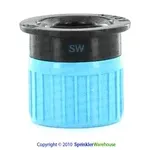
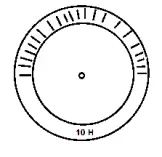
Look at the top of a standard nozzle. You’ll see three things: a number, a letter and some lines. On this sample the “10” means 10 foot radius, the “H” means Half Circle, or 180 degree coverage, and the line indicate the spray area. This notation is standard throughout the industry. A full circle nozzle has the distance and pattern but no line marks.

Specialty Nozzles

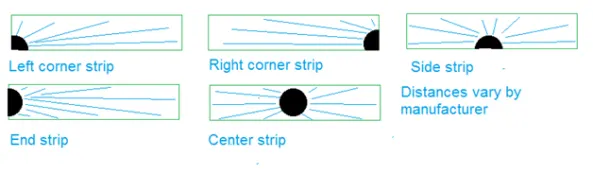
There are nozzles designed just for gardens and small areas. These are strip nozzles. Their patterns are as shown below.

sprinkler nozzle strip pattern diagram

Variable Nozzles

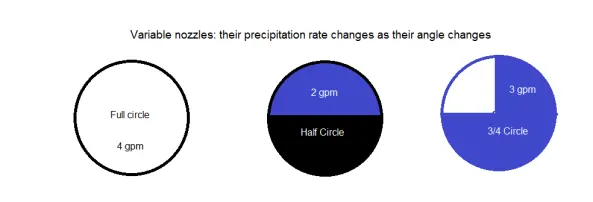
Variable nozzles are just that: variable. They can adjust spray patterns from 00 to 3600. Marking on these are usually the radius and either A for adjustable or VAN  or simply arrows pointing in both directions. These are excellent for small or unusual angles. To adjust you just turn the top ring or the side ring, depending on manufacturer.  Extremely versatile.

variable arc nozzles spray pattern diagram

Other

Every manufacturer has specialty nozzles. Some are low angle, some are low flow, some have different nozzle design. Each has its benefits.  All, however, fall back to the same basic descriptions: they all have a radius/distance marking, they all have a pattern description.

Precipitation

There can be a great deal of difference in the amount of water two nozzles from different companies put out. For example a Hunter 15’ full pattern standard nozzle at 30psi puts out 3.72 gallons per minute (GPM). A Toro Precision series, same radius, pattern and pressure, puts out 2.31gpm.  That is a difference of 1.41gpm per minute.  Both fit a need and have a specific purpose. However, you do not want to mix the Hunter and the Toro on the same zone. You will either over or under water one area.

It is important to stay with the same manufacturer on nozzles to keep the same precipitation rates.

One Final Note

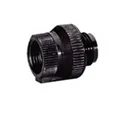
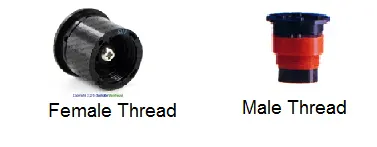
Most nozzles are female thread and will swap brand to brand without a problem. Some nozzles are male thread and are for certain brands only. Female thread tends to dominate the industry but make sure of what you have before you purchase replacements.

sprinkler nozzle threads

Every thing is good. You have the right tires, an actual indoor privy and perfect coverage for your yard.

But it is cheaper this way…irrigation parts, performance and problems.


A fact: some parts are cheaper than others. I’ll give you another fact: sometimes the cheaper part is as good as or better than the more expensive part. Why then wouldn’t you save money by buying the cheaper part?

There are a number of ways to save money. Sometimes it is by buying the least expensive part. Other times it may be by buying the most expensive part. Sometimes it is by cutting coupons. It’s a mixed bag. So how do you get the most return on your dollar? Simple: buy the most efficient product for your system and your life style; the product that works best with your system, providing the best service over a period of time. But best doesn’t only mean mechanically. It means best as in “efficient mechanical performance with the fewest demands on the owner’s time and effort.”

Nozzles

Let’s talk about sprinkler nozzles for a moment. We’ll compare Rain Bird, Hunter and K-Rain in a 12’, full circle spray. There is about a $0.50 spread from low to high. They all work; they all put out 12’ of water in a full circle. The yard gets wet.K-Rain Sprinkler Nozzle

The problem is the Toro nozzle puts out 2.19 gallons per minute (GPM). The other two put out around 2.65 GPM. So if you have a system with Toro nozzles and put in one Hunter or Rain Bird nozzle then that area will be over watered, harming the grass, water will be wasted and you will pay for that wasted water. Conversely, if you put a Toro head on a Hunter zone then that area will be under watered, may start to suffer and you’ll wonder why. The least expensive is whatever is the most efficient for your design. To find the correct nozzle for your system, go HERE.

Rotors

Let’s look at rotors for a moment. We’ll compare the Hunter PGP against the K-Rain RPS75. These two rotors are almost identical in design. However, the nozzles they come with are not. If you have 40 psi of water pressure and you need to spray 40’ their water volume differs. One uses 3.0 GPM, one uses 4.3 GPM. Your system will be designed for one or the other. If you mix them then one area will be over watered or another will be under watered. Cost to you if you install the wrong ones? Lots of head scratching and frustration as you watch lawn problems develop.K-Rain Rotor

Remember, a well designed system will water your yard in the most economical and efficient manner possible. As in many things, consistency and uniformity are important. When you change the design by mixing in unmatched parts just to save a few dollars, or more expensive parts because you like the brand name, you can cost yourself money, time and stress wondering why your yard is no longer as healthy as it was.

More Information

As always, you can come to Sprinkler Warehouse for more information. We’ll be glad to help.