You filter your coffee, you filter air. Really should filter your irrigation water.


The water going to your irrigation system is probably not as clean as you think. Even if you have municipal water from the best city supply in the country (Austin, TX, Des Moines, IA, Sioux Falls, S.D.) that water has to get to you through old pipes. Many cities still have cast iron pipes as their main lines, some dating back over 100 years. Most homes built before the 1960s have galvanized piping.  Pipes tend to fail from the inside, losing minute rust and other particles into the water. Add in the occasional sand particles that get in the water when pipes or pumps break and are fixed, plus the minor debris caused by cutting and repairing pipes, and there is a whole flotilla of little particles floating in your water.
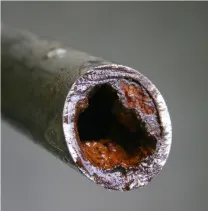
At this point you are probably thinking “Wait a minute! I drink that stuff! All that garbage goes into me!” Yes, it does. However, your body is better adapted to handling it than your sprinkler system. Besides, didn’t your doctor always tell you iron was good for you? Back to the pipes…

All of these particles go into your irrigation system and accumulate in valves, sprays and emitters. This causes decreased performance and a steady increase in maintenance. It also costs you money in ways you might not expect.  The thing to do is stop it before it happens.

A common problem with irrigation valves is failing to close completely. This leads to water seepage through the spray heads, wasting a great deal of water. Many times the problem is just grit or debris keeping the diaphragm from seating.
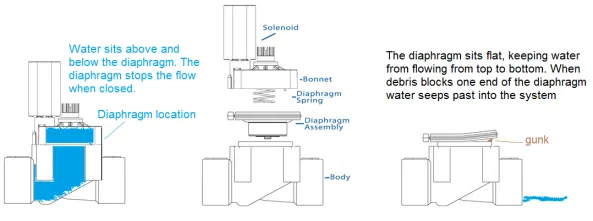
What you didn’t know it cost you: paying to fix something that is not broken. When you call a service tech (me) out for a leaking valve chances are good the first thing I will do is replace the valve. Generally I won’t even bother to see if it just needs cleaning. This is not done to save time. It is far quicker and easier to open and clean a valve than it is to cut the pipes and replace the valve.

I do it because people tend to be unhappy paying for service. People get really unhappy when charged for a service call and I look at them and say,  “Nah, I didn’t have to replace anything. I just wiped it off with a rag. It’s fine. Please pay me for one hour labor.” People like seeing things replaced. New is always better, right?

The debris also accumulates in your spray nozzles, causing pattern changes, reduced coverage distance and eventually complete blockage. These are easy to clean: tooth pick, tooth brush and running water. A tech will never clean them. It does take longer to clean these than to replace them.

The best thing to do is avoid these problems all together. Install a T-style filter.
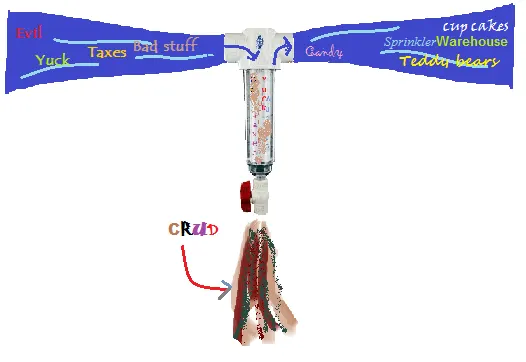
The Vu-Flow screen filters keep out sand and debris. The body is clear so you can instantly see when the filter needs purging or cleaning. To purge, just open the valve on the bottom. The trapped dirty water flows out. If the filter needs washing unscrew the body, remove the screen and clean. You don’t need to dry it off, it’ll get wet anyway.

Various screen sizes are available for different debris sizes.

Sediment
In Water

Use
To Protect

Type To Use:
(Mesh; Micron; Inches)

Coarse Sand; Shell

Sprinkler heads

30 mesh; 533 micron; .021″

Medium
Sand/Grit
Pipe scale;
Well Cuttings

Solenoid Valves
Gear Drive Sprinkler
Domestic Water

60 mesh; 254 micron; .010″
100 mesh; 152 micron; .006″

Fine Sand/Silt

Poultry drinkers
Household well water
Drip Irrigation
Fogger Sprayer

140 mesh; 104 micron; .004″
250 mesh; 61 micron; .0024″

T-filters are easy to install and maintain. Filtering your water extends the life of your valves and nozzles. Maintenance becomes less frequent, saving time and money.  All in all, a relatively minor investment with pretty good return.

Don’t listen to your sprinkler repair man. Better yet, don’t ask.


I’ll start by telling you that’s what I do. I repair sprinkler systems. This does cause a problem, as I’m telling you not to listen to me. Luckily, that’s handled by quantum metaphysics and we can skip ahead.

We are frequently asked: “What’s the best —?” Truth is, we usually don’t know. What we do know is what works for us. We have two basic requirements: we want to make a profit on the repair and we want the product to be good enough that we are not called back for warranty service. This defines our ‘best’ product.

We lose money on warranty repairs. This is bad.

We are also a conservative bunch. We don’t want to be the first one to try the new product and see if it lasts. We go with what we know.  We use the same rotors, the same controllers, the same pop-ups time and again.  I’ll go over a few of those and what might be better.

Pop-ups and nozzles

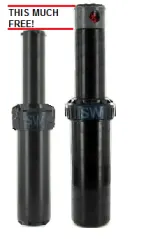
The Rain Bird 1800 series is one of the most popular popups out there, if not the most popular. It’s my default purchase. Why? Because in the years I was training my supervisors told me to go with the 1800s. Who am I to argue with the boss? Therefore it’s what I know and what I recommend.

What about the Hunter Pro Spray, Toro 570Z, and K-Rain 7800? All good, all in the same price range. The one you’ve never heard of, the K-Rain, might have the best seal in the bunch. Looks that way in drawings and specs. However, I install 1800s and don’t want to experiment.  See the problem here? I’m passing on a potentially better popup available at the same price just because I don’t want to try it and risk a warranty call.

How about nozzles? Rain Bird, Hunter and K-Rain are all extremely popular, pretty much same precipitation rate, all in the same price range. Which is best? Might be the Toro Precision nozzles. In a 12’ full circle spray they use about 1.3 gallon per minute less. Other sizes have similar savings.  Minimizes run off, helps with low gpm systems, and has an efficient pattern.  Why don’t I use and recommend them? They cost twice as much, if not more, than the others. People don’t want to pay for something they really can’t see and one nozzle spraying water looks like any other.

A quick note about something you’ve never heard of: K-Rain. K-Rain makes good products, has 90+ patents in the industry, is very competitively priced and apparently has one of the worst marketing programs around. Have you ever heard of it? People who don’t have irrigation systems know of Rain Bird, Hunter and Toro. There are many pros who don’t know about K-Rain. It’s hard for someone to recommend something they’ve never heard of.

Rotors

The most popular rotor out there is the Hunter PGP. Sells by the tens of thousands. Is it the best? Don’t know.  I sure put in a bunch of them. To be honest I like the Rain Bird 5000 “Rain Curtain” spray coverage better. The Toro T5 and the K-Rain 11000 series are in the same price range but you get a 5” pop-up instead of a 4”.  An extra inch for nuthin’. But people know Hunter and it works so I stay with it.

Controllers

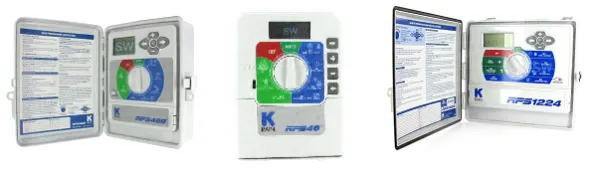
I like and install Hunter. Good and reliable. That’s not the main reason I install it. Look at the face of Hunter controllers. They all look the same. I don’t have to worry about going to service a system and having to remember different brands or carry manuals with me. And, of course, I tend to recommend Hunter for the same reason.

Now look at  K-Rain series. Their controllers  are usually lower than both Rain Bird and Hunter, they also have a standard front and they are reliable. I could save you money by installing them if I were a bit more adventurous. Unfortunately, I’m a coward when it comes to money and warranties.

The point to all this is that your repairman will give you a safe answer. He works in the field all day, knows what works for him and  makes his life easier. The product might or might not be the best but it will be safe for him to recommend and it will work.

There are a lot of products out there that don’t get the exposure they should. Check our site for ideas. At Sprinkler Warehouse we try to give you all the details along with links to different manuals. A lot of information there to help you make a better choice and far more variety than many repair people have ever seen.

Specialty nozzles to nuzzle.


Ok. Not nuzzle. Couldn’t think of a good title. Some people say I never do.

I’ll get down to business. Most people know about the average, used everywhere nozzles. If you don’t then check out sprinkler nozzles. These generally do the job and are all most people will ever need.

There are a number of specialty spray nozzles available for increased water efficiency, problem areas or special applications.  Normally I avoid naming particular brands and products, preferring to give general information. This is the exception.

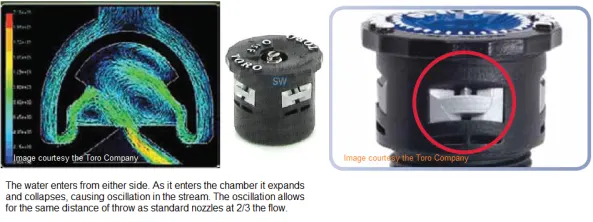
The first is the Toro Precision Series spray nozzle. While this is not technically a specialty nozzle it has some advantages over competing spray nozzles. The Precision Series has something they call H²0 technology which puts an oscillation on the spray . I’m sure the H20 name has nothing to do with the scientific name for water. Pure coincidence.  Anyway, quoting Toro, “Using patented H²0 chip technology – and no moving parts – each Precision Series Spray nozzles creates one or more high frequency oscillating streams to achieve the desired arc and radius with 1/3 less water usage.”  Yup. Sounds cool. But looks even better.

Ok. Pretty pictures and lots of marketing fluff don’t mean much without the facts. Comparing the Toro Precision nozzle to two major competitors:

Radius/ Feet Pattern GPM @ 30 psi Difference GPM
Toro 15 Full circle 2.31 —–
Brand A 15 Full circle 3.72 +1.41
Brand Z 15 Full circle 3.70 +1.39
Toro 15 Half circle 1.16 —–
Brand A 15 Half circle 1.86 +.70
Brand Z 15 Half circle 1.85 +.69

You might ask “If these are so good, why aren’t more people using them?”  Good question. Thanks.  The only downside to these nozzles appears to be the price. The Toro Precision sells for roughly 2.5 times the cost of standard nozzles. That can make noticeable difference in installation costs for an entire system. However if you are in a retrofit or repair situation and need to have better control over your precipitation, fix a zone that has been expanded beyond capacity, or control run off on slopes they offer you some valuable options.

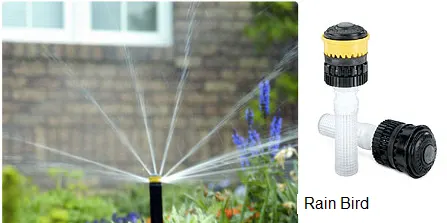
Let’s talk about Rain Bird Rotary Nozzles.  These cover a radius of 13 to 24 feet. Their big advantage is the ability to match these to the Rain Bird 5000 rotor series and get the same precipitation rate.  Let’s say you have a large area that will be covered by rotors and a small area next to it, say 20’ x 20’. Normally the smaller area would require its own zone using spray heads on pop ups. With Rain Bird Rotary nozzles you can now cover the area with one zone and get the same precipitation rate. Use the 5000 rotors for the large area, the rotary nozzles for the small one. You’ve eliminated one valve, the wiring and one zone requirement on the controller.

Because of their low precipitation rate they are very good for watering slopes. The slower precipitation rate gives the soil more time to absorb the water, minimizing run off.

Next is the Rain Bird U-Series.  In a perfect system you have head to head coverage. Most sprays do well on the far  coverage but lack real coverage in the first couple of feet out from the nozzle. Head to head coverage means that the area missed by head A is now covered by head B. In many cases, due to poor design, changing landscape or deteriorating systems, this no longer occurs and you get dry areas around the head. The U-series has a second nozzle for greatly improved close in coverage. While not as good as head to head coverage it sure comes close.

This is beginning to sound like a Rain Bird advertisement. Not intentional, it’s just the way the nozzle sprays…

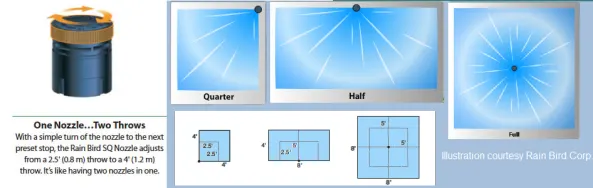
Now we have the lovely and talented Rain Bird SQ series nozzles. The SQ stands for square pattern. These put out a true square or rectangular pattern with edge to edge coverage. Most square pattern nozzles aren’t. On that I can speak from experience.

The SQ offers two settings so one nozzle throws 2.5′ or 4′, changeable with a simple twist of the top ring. It has a pressure compensator built in and fits standard pop ups and risers. It is also pretty low flow, using only .46 gallons per minute at its largest setting. Having a square pattern helps eliminate the waste that occurs when you try to match half and quarter circles to cover a narrow rectangular pattern.

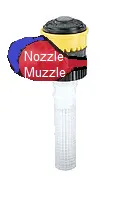
And remember, if you are getting enough rain you need to muzzle your nozzles. Get a sensor.

And How Did You Tie Corvettes Into Sprinkler Nozzles?


Life is good. You just bought your first Corvette with all the features: 6.2 liter 430-hp LS3 V8, Bose® audio system, head-up display and, to top it off,  Mickey Thompson Baja Claw TTC radial tires for off-road mudding! Race track here we come!

Life gets better! You just moved into your dream home: ocean view, indoor pool, master chef kitchens (two, so you don’t have to walk too far), a personal theater furnished by Home Theater Gear, a private elevator and, out back, your own personal outhouse!  Time for a party!

In any system all parts must work equally to achieve the desired results. Let’s trade the Baja Claw tires for Goodyear Eagle F1 Run-Flats and see if we can’t get some plumbing into your new mansion.

Nozzles are the final and one of the most critical parts of your irrigation system. It does not mattop of a sprinkler nozzleter how good the system is; putting in the wrong nozzle will make it ineffective and a money waster.

Understanding nozzles is simple. For one, the notes you need are written right on top. It’s like having the answers to your history test on the same line as the question.

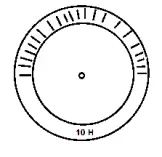
Look at the top of a standard nozzle. You’ll see three things: a number, a letter and some lines. On this sample the “10” means 10 foot radius, the “H” means Half Circle, or 180 degree coverage, and the line indicate the spray area. This notation is standard throughout the industry. A full circle nozzle has the distance and pattern but no line marks.

Specialty Nozzles

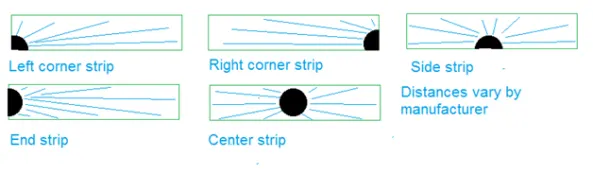
There are nozzles designed just for gardens and small areas. These are strip nozzles. Their patterns are as shown below.

sprinkler nozzle strip pattern diagram

Variable Nozzles

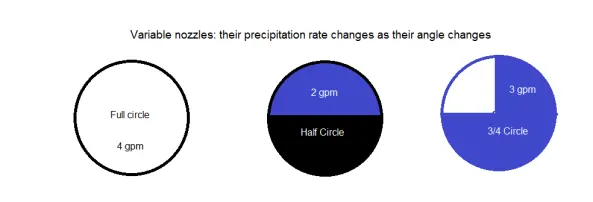
Variable nozzles are just that: variable. They can adjust spray patterns from 00 to 3600. Marking on these are usually the radius and either A for adjustable or VAN  or simply arrows pointing in both directions. These are excellent for small or unusual angles. To adjust you just turn the top ring or the side ring, depending on manufacturer.  Extremely versatile.

variable arc nozzles spray pattern diagram

Other

Every manufacturer has specialty nozzles. Some are low angle, some are low flow, some have different nozzle design. Each has its benefits.  All, however, fall back to the same basic descriptions: they all have a radius/distance marking, they all have a pattern description.

Precipitation

There can be a great deal of difference in the amount of water two nozzles from different companies put out. For example a Hunter 15’ full pattern standard nozzle at 30psi puts out 3.72 gallons per minute (GPM). A Toro Precision series, same radius, pattern and pressure, puts out 2.31gpm.  That is a difference of 1.41gpm per minute.  Both fit a need and have a specific purpose. However, you do not want to mix the Hunter and the Toro on the same zone. You will either over or under water one area.

It is important to stay with the same manufacturer on nozzles to keep the same precipitation rates.

One Final Note

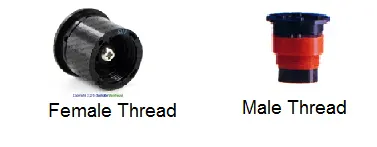
Most nozzles are female thread and will swap brand to brand without a problem. Some nozzles are male thread and are for certain brands only. Female thread tends to dominate the industry but make sure of what you have before you purchase replacements.

sprinkler nozzle threads

Every thing is good. You have the right tires, an actual indoor privy and perfect coverage for your yard.